Friday, 25 March 2016

New Members - B75592, 404565, 428569 (all Ungrouped)

The DNA results of the tests that people bought during the Christmas Sale are beginning to trickle in. As a result we have new members in four of the existing genetic families (R1b-GF1, -GF2, -GF4, & -GF5) and I'll be discussing these in subsequent posts.

However three new members received their results recently, and none of them match any of the members in the currently identified genetic families within the Farrell DNA Project. However, each of these new members has their own unique story as revealed by their DNA.

New Member - B75592, Farrell, MDKA Ireland

Basic information

Kit Number: B75592

Name: Farrell

Current Group: Ungrouped

MDKA: William Farrell, Ireland

Background: The Most Distant Known Ancestor (MDKA) is believed to have been of Irish descent.

Other projects: in accordance with our recommendations (see Getting the Most out of your DNA Test), he has joined several appropriate haplogroup & geographic projects including the following:

STR marker profile

He has no matches at 111 markers, 110 matches at 67 markers, 32 at 37, and 343 at 25 … but there is not a Farrell among them, and his closest matches within the project have a Genetic Distance of 8/37,  12/67, and 20/111. This indicates that there is no one in the project with whom he shares a common ancestor for probably 1000-2000 years.

It may be that there was an NPE (Non-Paternity Event, such as a secret adoption, infidelity, etc) somewhere along his direct male line (back in the mists of time) or that he is the first of his particular branch of Farrell’s to take the test. Thus, for the moment I have placed him in the Ungrouped section of the project but this is likely to change as more people test and join the FamilyTreeDNA database - eventually he should be paired up with a match. 

Next Steps: Testing his most distant documented Farrell cousin (if he can locate one) could help to ascertain if there has been a relatively recent NPE (i.e. in the last few generations). If his cousin is an exact or close match to him, then any NPE would have to have occurred prior to their common ancestor (grandfather or great grandfather, for example).

SNP marker profile

This individual's Haplogroup assignment is simply R-M269 i.e. M269 is the terminal SNP. This SNP marker is very far upstream in the human evolutionary tree (it appeared about 13,500 years ago). However, by reviewing his matches’ terminal SNP markers, we may be able to predict which downstream SNP markers he is likely to test positive for. Here are the terminal SNPs of his matches (at 67 markers):
  • A1206
  • A260 x5
  • A5902 
  • A725
  • A883
  • A887
  • DF105
  • DF109
  • FGC12948
  • FGC4077
  • FGC8739
  • M222 x13
  • S588 x2

By placing these markers on the FTDNA haplotree (we could also use the ISOGG Haplotree or YFULL Haplotree, among others), we can estimate on which branch of the human evolutionary tree this individual is likely to sit, and the good news is that every one of the SNP markers falls under M222 so we can be 99% certain that he would test positive for this SNP marker. This marker was formed about 4300 years ago and so testing positive for this SNP moves us down the human evolutionary tree by almost 10,000 years.

And as M222 is the genetic signature of Niall of the Nine Hostages, the famous Irish warlord, we can be reasonably sure that this person's ancestry goes back to Ireland. We can also estimate that his likely SNP progression (based on the preponderance of the evidence) is as follows:
R … DF49 > Z2980 > Z2976 > DF23 > Z2961 > M222 > S658 > DF104 > DF105 > A1206 > A260 > (un-named SNPs x2) > A883 / A887
SNPs in bold are the ones found among his matches that fit this estimated progression. This analysis is also born out by the terminal SNPs of his matches at the 25 marker level, so there is a reasonable chance that this estimated SNP Progression is correct.

Next Steps: So to clarify the above, we could either do the single M222 SNP test ($39) followed by the M222 SNP Pack ($119) or go straight to the M222 SNP Pack, which is what this member chose to do.

If the SNP Progression is correct (and he is on the A883/A887 branch), then this would place him in Alex Williamson’s Big Tree next to a Mr Riley and a Mr Flynn ...

The lower branches of the M222 portion of the human evolutionary tree

Furthermore, on the YFULL tree we can get an estimate of how old these SNP markers are and this tells us that the A260 SNP was formed about 1450 years ago (550 AD) and so he, Riley and Flynn share a common ancestor some time after that. More precise estimates will follow in time (as more people test and join the different company databases).

A260 is about 1450 years old


click to enlarge
Update: his M222 SNP Pack results arrived just as I was about to publish this post. And as predicted, he is positive for M222. His new terminal SNP is S566 and his SNP Progression is as follows:
R … DF49 > Z2980 > Z2976 > DF23 > Z2961 > M222 > S568 > S566

This SNP (S566) also goes by the name of FGC453 (many SNPs have alternative names, just to confuse us) and currently (on the YFULL tree) there is no time estimate of when it was formed, but we know it was some time after M222, which is 4300 years old.

Interestingly, this SNP progression places him on a different sub-branch of the M222 portion of the tree than that predicted above (see green arrow in diagram below). He has tested negative for the predicted SNPs S658, DF105, A1206, A260, A883, and A887. His nearest neighbours are now a Conroy and a Byrnes. Both of these are Irish surnames and this further supports an Irish origin for this particular Farrell branch.

The fact that the more downstream SNPs (below M222) are not as we had predicted suggests that there is quite a bit of Convergence (genetic overlap, for want of a better expression) among the lower branches of the M222 portion of the human evolutionary tree. If we look back at the terminal SNPs of this individual's matches, we can see that whilst the majority predict one particular downstream progression (red arrow), other SNPs are quite widely distributed within the M222 sub-branching system as indicated by the yellow circles below.
Red arrow is the predicted sub-branch, green arrow is the actual sub-branch (click to enlarge)

Further update (25 March 2016):
Susan Hedeen, one of the Administrators of the R-M222 Haplogroup Project, has kindly provided the following feedback having looked at the SNP results in the Farrell project SNP Pages for this individual. Susan has been able to predict a few additional downstream SNPs and a give an estimate of 800 AD for the emergence of the most downstream SNP
You are also derived for FGC440 that is downstream of where we believe PF1169 is located. This is the path as we believe that we know it now: S568>S566>PF1169>FGC440/FGC450/FGC456<--these thus far are considered equivalent, and FGC450 and FGC456 as well as these downstream-->FGC452/FGC455/FGC456 may be tested at YSEQ (FTDNA does not single SNP test for any of the others).
You would join these men who are also derived for FGC440
Bain
Byrnes
Conroy
Dunn
Dunne
McCabe
The Time to the Most Recent Common Ancestor (TMRCA) for the men above is 1150+/-260 ybp for a timing window of 540-800-1060 CE (current era); all before surnames.

Further update (20 July 2016):

During a routine audit of this project members results by FTDNA, it was discovered that the wrong results for the M222 SNP Pack had been uploaded to his account! He was notified in late June that the correct results had been uploaded and verified for accuracy.

The new results give this member a new terminal SNP, namely BY3338, which sits immediately above the terminal SNP(s) we had predicted from his Matches' Terminal SNPs Analysis (namely A883 / A887). Previously the two SNPs above A883 / A887 had not been named (they were simply referred to by their position on the Y chromosome) but since then one of them has been given a name - BY3338. YFULL dates SNP A260 (the one upstream of BY3338) as having formed about 1550 years before present, so BY3338 would have formed some time after that (it does not currently appear on the YFULL tree).

The new terminal SNP is BY3338, shared by Moody & Ford
(click to enlarge)


This BY3338 SNP marker is shared by two other people - Moody and Ford - names which appear among his 119 matches at 67 markers (he has no matches at 111 markers). If this Y-DNA is the result of an NPE (non-paternity event), then either of these surnames could be the surname of the genetic ancestor from whom this member's Y-DNA was derived. The Moody match has an MDKA (Most Distant Known Ancestor) from Ohio, the Ford match has an MDKA from Leitrim, in Ireland. However, this is the only time such names appear among this member's matches (at the 67, 37, & 25 marker level) so there is no strong signal for either of these particular surnames and the surname of the genetic ancestor could be something completely different.

Turning to the M222 Haplogroup Project, this project member sits in his own discreet grouping. However, the grouping of project members under A260 (the SNP 1-step upstream from BY3338) demonstrates an array of different surnames, albeit Irish-sounding, and several with MDKAs from Leitrim. Hopefully, as more people join the database and get SNP-tested, a closer match will be found and this may give clues to the ancestral origin of our member and to which particular surname he is most strongly related.

There are several Take Home Messages from this turn of events:
  • everyone makes mistakes, even the lab
  • the Matches Terminal SNPs Analysis (MTSA) correctly predicted the SNP progression to within a single branch of the new terminal SNP and appears to be a robust method of predicting the terminal SNP to within a few adjacent branches (in most cases?)
The varied names of those A260+ individuals in the R-M222 Haplogroup Project


New Member - 404565, Farrell, MDKA Ireland


Basic information


Kit Number: 404565

Name: Farrell

Current Group: Ungrouped

MDKA: Thomas Farrell, Ireland

Background: The Most Distant Known Ancestor (MDKA) is believed to have been of Irish descent.

Other projects: in accordance with our recommendations (see Getting the Most out of your DNA Test), he has joined several appropriate haplogroup & geographic projects including the following:

STR marker profile


He did the Y-DNA-37 test and at the 37 marker level he has 3 matches - no Farrell’s, but 2 Bradshaw’s and what looks like someone called Brannin. At the 25 marker level, he has 6 matches - again no Farrell’s, but the names of his matches look quite Irish (Fitzpatrick, Dalton, Gough, and even Ronan and Keating).

I also checked his “Genetic Distance” (GD) compared to everyone else in the Farrell DNA Project and his closest match among our members has a GD of 13 out of 37 i.e. he is 13 mutations away from his closest Farrell project match. That could be because his particular Farrell branch is quite rare and he is the first of the branch to test, or it could be that there may have been an NPE somewhere along his Farrell line within the last 1000 years or so, since the emergence of the Farrell surname. An NPE is a non-paternity event, such as an adoption, infidelity, etc, and the likelihood of this happening is about 1% per generation which is somewhere in the region of 33% over 1000 years (allowing 30 years per generation). In other words, about one third of us will not be genetically descended from the originator of our surname.

So for now, he has no close matches within the Farrell DNA Project but this may change over time as more people are tested.

Next Steps: Because he does not match anyone else within the Farrell project closely, I think that the chances of finding new Farrell matches by upgrading his 37 marker STR test to a 67 or 111 marker test are very slim indeed. However, we might find other non-Farrell matches (such as Bradshaw’s - his closest current matches). This could give us further clues to the origins of his direct male line. However, upgrading is not cheap - a 67-marker upgrade is $99 and an 111-marker upgrade is $220.


SNP marker profile

We have one further clue about the possible origins of his direct male line, and that is the terminal SNP marker of one of his matches, namely R-FGC5494. This is placed on the human evolutionary tree (Y-Haplotree) as follows:

R .. > M269 > L169 > L23 > L51 > L151 > P311 > P312 > L21 > DF13 > FGC5494

If this member shares the same SNP as his match, this would place him still fairly upstream in Alex Williamson’s Big Tree. This particular section of the tree has quite a few English and Welsh people, with some Scottish and Irish, but there is no particular preponderance of one or another nationality so this does not give us many clues to the origins of this direct male line (other than "somewhere in Britain or Ireland"). 

Next Steps: We would need to do some further testing to see a) does he also have the above SNP marker; and b) can we identify any further SNP markers “downstream" that would give us a better clue to the country origins of his direct male line. In order to do this, it looks like he would need to do the R1b-M343 Backbone SNP Pack ($99) followed by a "more downstream” SNP Pack (if there is an appropriate one currently available).


New Member - 428569, Ferrell, MDKA Ireland

Basic information

Kit Number: 428569

Name: Ferrell

Current Group: Ungrouped

MDKA: unknown

Background: unknown

Other projects: in accordance with our recommendations (see Getting the Most out of your DNA Test), he has joined several appropriate haplogroup & geographic projects including the following:

STR marker profile

So far, his Y-DNA-67 results indicate that he is not a close match with anyone in the Farrell DNA Project. The Genetic Distance to his closest matches among Farrell project members are 10/37 and 17/67 indicating that they are very distant indeed and I have placed him in the Ungrouped section for now.

If there has been an NPE somewhere along his direct male line, it might be possible to get some clue as to the name of his genetic ancestor by looking at the frequency of surnames in his surnames list. He has 1 match (Bruner) at 67 markers, 1 at 37 (the same Bruner again), and 426 matches at 25 markers. A review of the names of his Y-DNA matches suggests a preponderance of the following surnames:
Anderson, Brown, Chandler, Chumney, Clark, Crow(e), Duncan, Grigsby, Hughes, Loucks/x, Martin, Matheson, May, McPheeters, Rodriguez, Spencer, & West
Any of these names might be the surname of his direct male line genetic ancestor. And because they sound English, they may very well indicate an English origin for his father's father's father's line.

Next Steps: further resolution might be achieved by upgrading to 111 markers but it is a bit of a long shot and may not produce further matches or further refinement of the candidate surnames for the genetic ancestor.


SNP marker profile

This project member did the R1b-M343 backbone test, which assigned him a terminal SNP of Z36. So his established SNP progression looks like this:
R … > M269 > L150 > L23 > L51 > L11 > P311 > P312 > U152 > Z36

His Z36 terminal SNP places him quite far downstream on the Y-DNA Haplotree (the Tree of Mankind) and you can see his genetic neighbours on Alex Williamson’s Big Tree here. I attach a screenshot of it below (Z36 is on the second "row" from the top). No particular surname or nationality jumps out so unfortunately this gives us no clue to the country of origin of his direct male line.

Next Steps: There have been further SNP markers identified downstream of Z36 (at least 16) but the only way for this member to be evaluated for these would be for him to do a Big Y test ($575) or test for them individually ($39 each). Before paying out that amount of money, it would be worth his while joining a few relevant Haplogroup Projects (which he has) and asking the Admins for advice on next steps. It is never any harm to get a second opinion!

Z36 is on the second "row" from the top


Summary

So all three of these new members have been placed in the Ungrouped section for now. Over time, as more people get tested, the hope is that new people will join the FamilyTreeDNA database and turn out to be a match to each of them in turn. Once that happens, the newly-matched member can be moved from the Ungrouped section into an entirely new group. And if we are lucky, his new match will have a direct male line pedigree that has documented evidence of a specific place of origin so that the project member, by extrapolation, can finally identify the ancestral homeland of his father's father's father's line.

But for now, it's a waiting game.

And good things come to those who wait ... 

... as we will find out in the next post.


Tuesday, 22 March 2016

New Member - 449094, O Fearghail, MDKA Ireland, Ungrouped

Basic information

Kit number: 449094

Name: O Fearghail

MDKA: not yet supplied

Background: not yet supplied. This new member hails from County Tyrone in Northern Ireland and bears the surname O Fearghail, which is one of the many Gaelic forms of O'Farrell (and has been covered in a previous post).

Other projects: in accordance with our recommendations (see Getting the Most out of your DNA Test), he has joined several appropriate haplogroup & geographic projects including the following: 

STR marker profile

He has a massive 160 matches at 67 markers and this suggests a degree of Convergence may be present. However he does not match any Farrell, which suggests either that an NPE (non-paternity event) is present somewhere along his direct male line (e.g. a secret adoption, infidelity, or illegitimacy) or that he is the first person in his particular genetic Farrell family to be tested. If the latter is the case then this becomes a waiting game for some other Farrell with a similar genetic signature to take the test and turn up as a new match to him. For the moment he has been placed in the Ungrouped section.

Reviewing his matches, many have ancestry from Monaghan, Armagh, and Cavan, and there is a strong suggestion of a close tie to the surname McMahon.


SNP marker profile

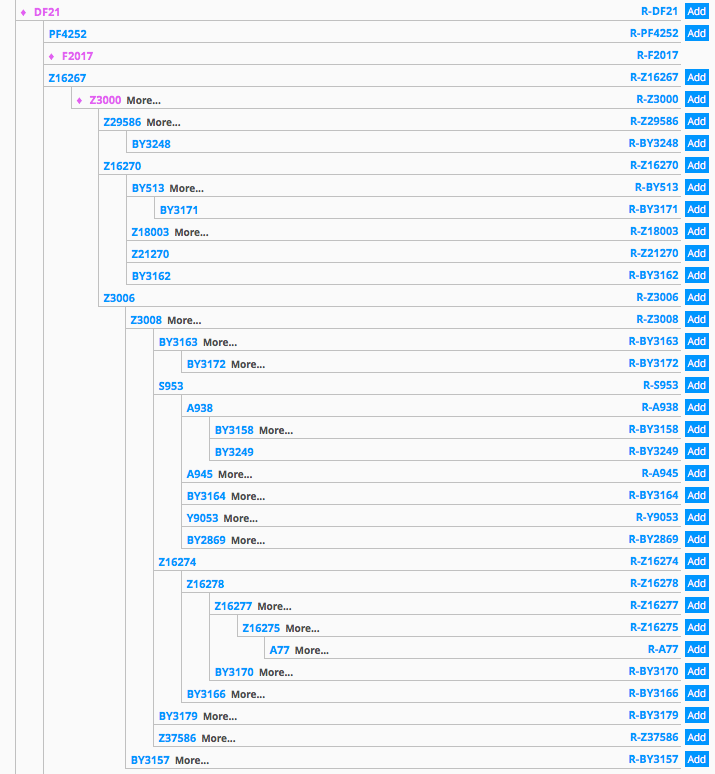
His terminal SNP seems to be A77 (again judging by the preponderance of his matches who share this SNP). This seems to be confirmed by the FTDNA haplotree which has R-A77 adjacent to other SNPs that occur frequently among his matches (e.g. BY3159, BY3166 & BY3170). His SNP progression therefore appears to be as follows:
R-L21 > DF13 > FGC35995 > DF21 > Z16267 > Z3000> Z3006 > Z3004/Z3008 > Z16274 > Z16278 > Z16273/Z16277 > Z16275 > A77
All the identified terminal SNPs of his matches fall below Z3004/Z3008, and most below Z16274. 


I checked this progression against Alex Williamson’s Big Tree at ytree.net and it places him fair and square in the Clan Colla / AirgĂ­alla type 1 group - you’ll find it at this link here and there is an extract below … the A77 group is 10th block in from the left.

click to enlarge

Next Steps

There are several possible next steps:
  1. He has already joined the appropriate Haplogroup projects (R1b & Subclades, Clan Colla) and additional Surname projects (McMahon, Carroll) and could ask the Admins for advice on further testing as well as further documentary research.
  2. He could explore his more downstream SNPs by testing for individual SNP markers or with one of the SNP Packs. There are single SNP tests available for each of the blue SNPs in the diagram above ($39 each), including A77. However, in case our estimate of his terminal SNP is incorrect, it may be wiser (and more economical than repeated single SNP testing) to go for one of the available SNP Packs (via the blue Upgrade button > Advanced Tests > SNP Pack):
    • R1b-M343 Backbone SNP Pack ($99) - this would only help him move downstream to Z3000 but no further
    • R1b-L21 SNP Pack ($119) - again, this would only move him downstream to Z3000
    • R1b-Z3000 SNP Pack ($119) - this would move him all the way downstream to A77 and would also clarify whether or not he was positive for adjacent SNPs. This would be the best test to undertake. The chances that his terminal SNP does NOT sit at or below Z3000 is (I would say) less than 1%.

Update (2nd March 2017)

FGC35995 is non longer part of the SNP Progression above. It has been taken out and the revised SNP Progression (from FTDNA) is as follows:

R-L21 > DF13 > DF21 > Z16267 > Z3000> Z3006 > Z3004/Z3008 > Z16274 > Z16278 > Z16273/Z16277 > Z16275 > A77


Tuesday, 1 March 2016

New Members - 449744 & B12101, Farrell, MDKA Ireland? - R1b-GF2

Basic information

Kit Numbers ending: -9744  &  -2101

Name: Farrell

Current Group: R1b-GF2

MDKA:
  • Francis Farrell b1753 Philadelphia d1825 NC (-9744)
  • Patrick Farrell b c1722 ?Philadelphia d c1783 PA (-2101) - the presumed father of the above

Background: The Most Distant Known Ancestors (MDKA) are believed to have been of Irish descent. The pedigree for kit -9744 has been posted as a Comment (23 Jan 2016) at the bottom of our Post Your Pedigree page here, and is reproduced again below. After comparing trees, these members discovered that they shared a common ancestor in John Wesley Farrell 1801-1873. He is great grandfather to -2101 and 2x great grandfather to -9744, making them second cousins once removed. This is a fine example of how Y-DNA testing can connect people who were not previously aware that they are cousins.

The direct male line of kit ending with -9744 is as follows:
1. Francis Farrell - b.1753 Philadelphia PA, d.1825 Chatham Co. NC, m.Edith Fields, Chatham Co. North Carolina, US
2. John Wesley Ferrel - b.1798 Chatham Co. NC, d.1870 m. Mary Polly Neal, Chatham Co., North Carolina US
3. George W. Ferrel - b.1845 Chatham Co. NC, d.1899 Chatham Co. NC, m. Martha G. Thomas, Chatham Co., North Carolina
4. George Monroe Farrell, Sr. - b.1883 Chatham Co. NC, d. Orange Co. NC, m. Vennie Elizabeth Honeycutt
5. George Monroe Farrell, Jr. - b.1917 Halifax Co. NC, d. Roanoke Rapids NC, m.Ruth Lee Haley
6. -9744

Here is an additional account from the family of member -2101:
Briefly, Dr. Francis Farrell was our first ancestor in Chatham County, North Carolina. He was born in Philadelphia in 1753, educated at the English Jesuit Academy in Bruges, Belgium, and evacuated Philadelphia in 1776 for Natchez, Mississippi (then British West Florida) at the start of the American Revolution, where he served as attorney for the district under the Spanish administration that followed the British loss of the territory. His father was Patrick Farrell, a well to do cooper in Philadelphia. Patrick's father was Andrew Farrell, a tanner and merchant with connections to Maryland and the West Indies who helped establish the first Catholic Church (Old St. Joseph's) in Philadelphia. His father seems to be Edmund Farrell, also a tanner, who is in Philadelphia in 1726. Here the trail runs out (at least for now) but based on the historical patterns some likely conjectures are that (a) Edmund was a tradesman who immigrated directly to Philadelphia from Ireland, (b) Edmund was a Catholic refugee whose family moved to Philadelphia as Maryland and before that Virginia became more intolerant (there is a noticeable progression of the Farrell surname from Virginia to Maryland to Pennsylvania that corresponds with religious tolerance in those provinces), (c) he was a Catholic merchant from the West Indies who moved to Philadelphia as economic opportunities arose (see the many Farrells in Barbados and the Leeward Islands, and the network of Irish merchants in the Atlantic), or (d) someone else.

Other projects: in accordance with our recommendations (see Getting the Most out of your DNA Test), both members have joined several appropriate haplogroup & geographic projects including the following: 

STR marker profile

Member -9744 has tested to 111 markers but has no matches at this level. He has 19 matches at 67 markers, 4 at 37, and 131 at 25 markers. His closest matches are in fact already members of the Farrell Project groups R1b-GF2a (Genetic Distance ranging from 4 to 5 out of 37) and R1b-GF2b (GD range 7-10/37 and 7-10/67).

Member -2101 was a Y-DNA-46 transfer (from Ancestry) and does not have a match list for this reason. Sadly this member has passed away and obtaining a further sample is not possible. Because of the limited functionality associated with this member's results, it is also not possible to compare his Genetic Distance to other project members using the usual tools available to Administrators. So we resort to a visual comparison of his results on the DNA Results page. And from this it appears he is a very close match to -9744, differing only at DYS442 (14>15), giving them a Genetic Distance of 1/43. Similarly, this additional mutation makes his GD 5 to 6 out of 37 when compared to other members of R1b-GF2a and 8-11 out of 37 for R1b-GF2b.

This places both members within the group R1b-GF2a (with a reasonable degree of confidence).

For -9744, Ireland comes up as a strong contender for ancestral homeland on both his Ancestral Origins page and his Haplogroup Origins page.


SNP marker profile

On examination of -9744's matches, at 67 markers the following "downstream" SNPs occur:
  • L21 ... x3
  • Z253 ... x1
  • FGC20561 ... x1

There are no new revelations at the 37 marker level, but at the 25 marker level, the following SNPs occur:
  • L21 ... x4
  • Z253 ... x8
  • FGC20561 ... x1
  • S845 ... x1
  • S846 ... x3
  • DF103 ... x1
So where do these SNPs sit in relation to each other on the human evolutionary tree and can we predict a SNP progression for these two members? There are three Haplotrees that we can examine, each with subtle differences in terms of where some SNPs have been placed on the tree by the authors - the ISOGG Haplotree, the FTDNA Haplotree, and the YFull Haplotree. For people in Haplogroup R, Alex Williamson's Big Tree is also very useful (for SNPs at the level of P312 or further downstream). Currently, the FTDNA Haplotree and the YFull Haplotree are the most useful, although the latter is more experimental (and hence perhaps more up-to-date).

All of the downstream SNPs among -9744's matches can be placed in a single continuous progression, except for the last one, DF103 (this is on a completely different branch). The progression of "consistent" SNPs is as follows (SNPs found among matches are in red):
  • R- ... M269 ... > L21 > DF13 > ZZ10 > Z253 > S847 > S844 > S856 > S845 > S846 > Z17685 > FGC20561

The above SNP progression is based on FTDNA's Haplotree but the other versions are broadly similar. 

Thus one would predict based on the SNP results of -9744's matches, that the terminal SNP of -9744 would be at or close to FGC20561. And if we see where this is located on Alex Williamson's Big Tree, we find that this particular branch is shared by several people with Irish ancestry sporting the names Yorke, Christie, Murta, & Deignan (see diagram below). This further supports Ireland as the country of origin of these project members (and in fact, all of their matches in R1b-GF2).

We could take this a step further by looking at Surname Distribution Maps and see where the adjacent surnames occur most frequently. This may give us some indication of where in Ireland (which county) this particular Farrell variant originates. But that is the topic of a subsequent post.

Z17685 (the penultimate SNP) is on the far left in Alex Williamson's Big Tree

Next Steps

  1. As these two members are quite closely related (2nd cousins once removed), they should show up as strong matches to each other on their autosomal DNA. -2101 has already done this test so if -9744 did it, he should find that he shares about 1.6% of his DNA with -2101. In addition, any of their joint matches (i.e. the same people showing up as a match in both of their matches lists) are likely to be related to them via their common ancestor, John Wesley Farrell 1801-1873. This would help focus their Farrell research and provide new avenues of enquiry and collaboration.
  2. It would be useful to confirm if the predicted SNP progression (and the terminal SNP) is correct. This would help our endeavours to isolate the country (and even county) of origin for these members. This could be achieved in several ways:
    • by testing individual SNPs ... but at $39 each at FTDNA and $17.50 each at YSEQ, this could turn out to be quite an expensive option in the long run.
    • by doing a SNP Pack. There are several available, the most "top-level" being the R-M343 Backbone SNP Panel, but this only drills down as far as Z253 on our predicted SNP Progression. There is a Z253 SNP Pack* (see the SNPs covered below) and this includes all of the SNPs in our predicted progression, so maybe the cheaper option would be to order this one instead ($119) ... and perhaps first confirming that -9744 tests positive for Z253 by ordering a single SNP test ($39).
    • via the Big Y test ... this is a "discovery test" and it will confirm most or all of the SNPs in the predicted SNP Progression and will probably identify new ones, including some that are unique to the individual doing the test. But at $575 it is expensive and it may not be necessary to answer all our questions, the chief ones being: does this DNA go back to Ireland? and if so, where in Ireland?
In the end, member 449744 decided to go straight ahead with the Z253 SNP Pack and we will update this post with the results in about 8 weeks time.

Maurice Gleeson
Feb 2016

R1b - Z253 SNP Pack
Includes the following SNPs on the haplotree:
Z253, Z2201, F1969, L226, CTS9881, FGC8244, A14, CTS3849, Z2186, CTS4314, A287, FGC17551, Z2185, Z2534, FGC17449, S15280, BY157, Z18132, S7898, FGC3251, FGC3221, PF825.2, FGC3222, L554, FGC3268, BY312, FGC20561, Z17685, S846, S845, FGC20563, L1308, S856, S844, S847, BY279, DF73, CTS10108, S23267, YFS231286, DC1, FGC5628, DC8, FGC12290, FGC5660, CTS4296, CTS9251, CTS12232, BY325, FGC20566, FGC3249, FGC3236, S7897, BY414, BY411, BY412, Z18123, BY410, DC25, FGC5659

Includes the following SNPs that are NOT on the haplotree:
BY127, DC29, DC30, DC36, DC39, DC41, Z18126, S8388, ZP155, ZP156


Friday, 19 February 2016

New Member - 442342, Farrel, Unknown origin, Ungrouped

Basic information

Kit Number: 442342

Name: Farrel

Current Group: Ungrouped

MDKA: John Farrel bc1880 Unknown dc1947 Unknown

Background: The Most Distant Known Ancestor (MDKA) is believed to have been of Irish descent.

Other projects: in accordance with our recommendations (see Getting the Most out of your DNA Test), he has joined several appropriate haplogroup & geographic projects including the following: 

STR marker profile

He did the Y-DNA-67 marker test and has no matches at the 67 marker level, 1 at 37 markers, and 36 at 25 markers, but there are no Farrell’s (or similar) among them. In fact, he doesn't even come close to matching any of the 118 Y-DNA-tested individuals in the entire Farrell DNA project. And this is because his genetic signature is unique among all project members - he belongs to Haplogroup E whereas most Farrell project members belong to Haplogroup R or I. As a result, for now, this new member has been placed in the Ungrouped (non-R) section.

However, as the project grows and more people join, we may find that he becomes the start of a whole new genetic family of Farrell’s. The Pater Familias if you will. This is not unusual and in fact is to be expected. Farrell is likely to be a multi-origin surname and I would expect quite a few more “genetic families” to emerge over the course of the next several years. 

We should also bear in mind the possibility that there may have been an NPE somewhere along his Farrel line within the last 1000 years ago or so, since the emergence of the Farrell surname. An NPE is a non-paternity event, such as an adoption, infidelity, etc, and the likelihood of this happening is about 1% per generation which is somewhere in the region of 33% over 1000 years (allowing 30 years per generation). In other words, about one third of us will not be genetically descended from the originator of our surname. C’est la vie.

If there was an NPE, we could get a clue to as to the surname of his biological patriarch by examining his closest matches. Unfortunately he does not have many. The one match at 37 markers is called Clark, and of the 36 matches at 25 markers there are 4 matches called Crow(e), 8 called Mason, and 4 called Stalnaker or Steinecker. These could be significant clues, or it could simply mean that there is a surname project for each of these surnames that is actively recruiting new members (and hence skewing the database with an over-representation of the surname in question).

SNP Marker Profile

His initial Y-DNA results placed him in Haplogroup E, subclade E-L117 (i.e. L117 was his terminal SNP marker, the one at the end of the branch), or to use the older terminologies, Haplogroup E1b1b1 or E-3b or E-M35 or E-M35.1. Apparently, this particular haplogroup arose in East Africa about 26,000 years ago and spread to North Africa and the Near East. It has relatively high concentration in the Balkans and is particularly prevalent in an Ashkenazi Jewish group. You can read more about the fascinating history of this haplogroup on the Eupedia website here.

His particular terminal SNP (L117) was equivalent to M35 and placed him quite far upstream in this particular section of the human evolutionary tree (just below M243, according to FTDNA's Haplotree & the ISOGG Haplotree - it was difficult to find on the YFull Tree because of the plethora of equivalent SNP names). 

Looking at his Y-DNA matches, his one match at 37 markers was of Scottish origin and had M78 as a terminal SNP. This placed the match on the downstream branch E1b1b1a1 characterised by the terminal SNP M78 aka PF2186 and apparently equivalent to L18, according to the ISOGG Tree. I guessed that our new member might also test positive for this SNP, in which case the SNP progression for his particular Haplogroup E subclade would be as follows ...
E- ... M96 > P147 > P177 > P178 > M215 > M35.1 (L117) > V68 > M78 … 
This particular subclade occurs most commonly in Ethiopia and the Balkans (see also Wikipedia here) and arose about 20,000 years ago (from time estimates YFull Tree). But this still did not narrow down his Y-DNA origins to just one specific location. It could have been of African origin, or it could have been of European origin.

Present day distributions of E-M78

I advised that further SNP testing would help place him on one of the downstream branches of this particular subclade and the Project Administrators of the E3b Project would be best placed to advise on a strategy for further testing. 

In due course, he ordered the E-V68 SNP Pack and the results came through 4 weeks later. He tested positive for SNP M78 (as predicted) but also tested positive for several "more downstream" SNP markers and his new terminal SNP became E-L241. This is indicated in the diagram below by the green arrow. He also tested negative for further downstream SNPs (indicated by red text). 

Abbreviated FTDNA Haplotree - predicted terminal SNP (red) and subsequent confirmed downstream SNP (green)

Whilst this new terminal SNP brings us further down the human evolutionary tree (further "downstream"), it still does not shed a huge amount of additional light on the ancestral origins of this new member's direct male line. This is largely because so few people have tested positive for this SNP that not a lot has been written up about it. I checked the DNA Results page of the E-M35 project for other E-L241 positive people and (although there are not many of them) most who had Old World origins seem to come from England.

The YFull haplotree gives us some indication of how old this particular SNP is and estimates that it was formed 4100 years before present (or about 2000 BC) - see diagram below. So we are still relatively "upstream" in the tree. 

YFull Haplotree - useful for dating the emergence of a SNP

Next Steps
  1. Upgrading to 111 markers could reveal some new matches but this is a long shot. It is more likely that this new member will have to wait it out and hope that as new people test and join the FTDNA database that some of them will turn out to be close matches to him. And some of these close matches will hopefully be related within recent genealogical times so that they can find documentary evidence of how they are connected. And working out this connection could help one or both of them break through Brick Walls in their own research.
  2. Further testing of additional SNPs would potentially place this individual even further downstream in the human evolutionary tree, would identify on which sub-branch below L241 he currently sits, and (if there is an NPE present) could ultimately identify the likely surname of the progenitor of his father's father's father's line. However, this would require either testing individual SNPs at YSEQ (because FTDNA do not currently test for any "more downstream" SNPS) or doing a "discovery test" such as the Big Y, which is a big step as it is quite costly ($575).
  3. Keeping in touch with the Haplogroup Project Admins and joining any associated Mailing Lists or Facebook groups might be the best way of keeping abreast of new developments in E-L241 research.


Maurice Gleeson
Feb 2016

Update July 2016

This project member upgraded to the Y-DNA-111 marker test, undertook the Big Y, and had the latter results additionally analysed by YFULL.

There are no additional matches at 111 STR markers but we knew at the start that this was a long shot. In addition, this project member has no exact matches on his Big Y test, and so has no nearby neighbours or cousins for the past several thousand years, making his a very rare genetic signature indeed.

The Big Y results revealed a new "terminal" SNP, namely BY5675. This is 1 step further downstream of the previous "terminal" SNP (L241) and places this project member on the haplotree as indicated below.

The placement of BY5675 on FTDNA's Haplotree


YFULL ages the SNP L241 as 3900 years before present but does not have BY5675 on its version of the haplotree (as yet), probably because this is a recently discovered SNP and also because not enough people with this particular SNP has joined the YFULL database (they need at least 2 people with this SNP to place it on their haplotree and estimate the TMRCA). As a result there is currently no age for BY5675 but it is likely to be a lot less than 3900 years old, possibly 3000 or 2000 years old.

The age of L241 is about 3900 years ago (from YFULL tree)

And so we turn to the Haplogroup Projects to see if there is any further information available. The E-M35 project has its own dedicated website. But there is no sign of BY5675 on the site, only L241. In this case it would be worthwhile contacting the Project Admin for further information.

Because this is such a recent discovery, we turn to a simple Google search to see if there might be  anything written about it on the various websites that host a DNA forum, and there are several possible avenues of further enquiry:
  • GENI.com host a project specifically for BY5675 that has 6 users but no discussion (as yet)
  • The Activity Feed from the E-M35 Haplogroup Project on FTDNA comes up in the Google search - it turns out to be the above project member asking the same question I am! (great minds think alike) ... unfortunately nobody responded.
  • And similarly, there's a hit on the Polish DNA Project ... again, it's the above project member. Ten out of ten for tenacity!

But no hints about where in the world this SNP came from originally? I searched for the SNP 1-step further upstream, namely L241 ... and I find lots of hits for the same project member asking all the relevant questions I would have. What a diligent chap! It's great to see we are both thinking in the same direction!
  • The Eupedia forum has some limited direction ... 
  • Wikipedia a little moreso but nothing beyond L241 ...
  • Eupedia itself has a cladogram for Haplogroup E1b1b (below) which has not been updated since Jan 2015
  • and the Anthrogenica forum refers us to another forum (Double-Helix, which host the forum for the E-M35 project) where there is some discussion of origins from the Balkans, but the last post was April 2015. However, several surnames are repeated among the L241+ DNA tests, including Baber, Johnson, & Stafford. It could be worthwhile contacting any Project Admins running these projects for any insights they might have. 

So the bottom line is that there is not a whole lot known about this particular SNP at the moment.

But that will change with time as more people get tested.


SNP L241 is 4th from the left in the bottom row
(click to enlarge)


Maurice Gleeson
July 2016


Wednesday, 17 February 2016

New Member - 433459, Farrar, MDKA Canada, Ungrouped

Several sets of new Y-DNA results have been posted to the project over the last few months and several new ones are expected shortly. It's good to see the project growing!

I will be summarising these new results and how they fit in to the overall project in a series of blog posts over the course of the next few weeks. And to start off with, here is the first one.

Basic information

Kit Number: 433459

Name: Farrar

MDKA: John Farrow b 1810 PEI d 1872 - 1880 N.B. Can

Background: The Most Distant Known Ancestor (MDKA) is John Farrow born 1810 Prince Edward Island, died 1872-1880 New Brunswick, Canada. There is some uncertainty in the family if the ancestral surname is Farrow or Farrar as the two names were often used interchangeably. His ancestry was thought to be northern England, perhaps Norfolk, but do the DNA results bear this out?

Other projects: in accordance with our recommendations (see Getting the Most out of your DNA Test), he has joined several appropriate haplogroup projects including the following:


STR marker profile

He did the Y-DNA-67 marker test and has 168 matches at the 67 marker level but there are no Farrar’s, Farrow's or Farrell’s. In fact, the closest he comes to anyone in the entire Farrell DNA project is a Genetic Distance of 12 out of 37, which is very distant indeed and suggests no common ancestor for several thousand years with any of the Farrell group members. As a result, for now, this new member has been placed in the Ungrouped (Haplogroup R) section.

He also joined the Farrar DNA Project but has no close matches there either. So it may be that he is the first Farrar to test from his own particular branch of the Farrar family or that there was an NPE (non-paternity event e.g. adoption, infidelity, etc) somewhere along his ancestral line in the last 1000 years or so.


If there was an NPE, we could get a clue to as to where the Y-DNA came from by examining his closest matches. The most common surnames that occur amongst his matches include Campbell (x40) & Stewart (x8). And many of his matches come from Scotland and Northern Ireland, suggesting that his direct male line was originally Scots or Scots-Irish. The predominance of Campbell among his matches is highly suggestive of a Campbell being the progenitor of his direct male line.

SNP Marker Profile

Similarly, we can deduce from his closest matches what his terminal SNP is likely to be and this in turn might give us a clue as to the possible origins of his Y-DNA. The most common downstream terminal SNPs among his Y-DNA matches are:
  • L1335 … x4
  • L1065 … x4
  • CTS7030 … x3
  • DF13 … x3
I looked to see where these were situated on the YFull haplotree and FTDNA Haplotree, and here is what I found:

  • DF13 is relatively upstream and the SNP progression is as follows ...
    • L21 > DF13 > L1335 > L1065 / CTS7030
  • L1335 sits below DF13 and was formed about 4200 years ago.
  • L1065 is actually equivalent to CTS7030 (x3 matches) and CTS6838 (x2 matches). It sits just below L1335. It was formed about 3600 years ago.
  • So the most likely candidate for his terminal SNP based on the above is L1065.

I looked to see if we could perhaps travel a bit more downstream. And indeed, several of his matches have other SNPs below this one. Looking at his list of matches, the following more downstream SNPs occur:

  • FGC10117 x2 (a Campbell and a Ford), FGC10125 x2 (both Campbell’s). 
  • YFull puts these SNPs as equivalent to each other (i.e. at the same level = they are the same or adjacent SNPs) and has its own name for the SNP, namely Y7359. 
  • FTDNA has a slightly different placement but they all occur in more or less the same general area. 

So based on this data, it is most probable that this new member's terminal SNP is Y7359 or FGC10117 or FGC10125, as illustrated in the diagram below. In this situation, the next step would be to seek advice from the Haplogroup Project Admins on what additional testing options are recommended in order to confirm if this guesstimate for the terminal SNP is correct.

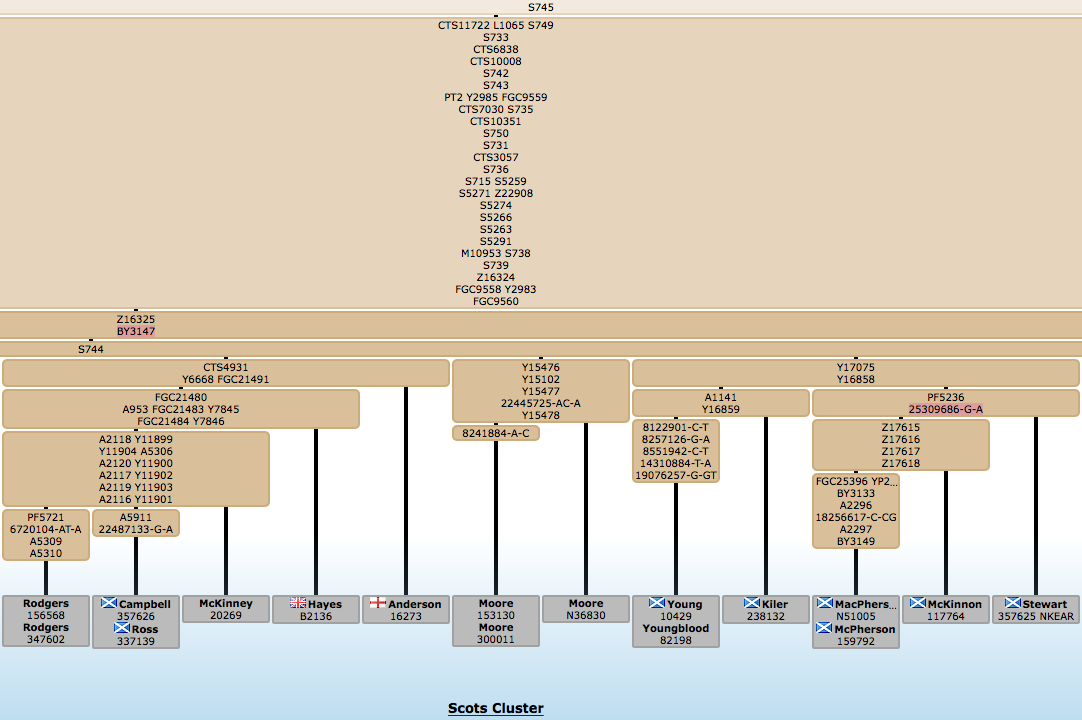
In fact, this member subsequently ordered the R1b-M343 Backbone SNP Pack (as well as the Y-111 upgrade). The SNP results came back with a negative result for FGC10125, but a positive result for  Z16325 (also known as S744). This became his new terminal SNP and in fact it is located on the adjacent branch to the SNPs that we guessed could be his terminal SNP. The diagram below shows their relative positions on the YFull haplotree.

The possible (red) and actual (green) terminal SNPs for member 433459 on the YFULL Tree

These results place this member in a distinctly Scottish cluster and his position on the evolutionary tree is nicely displayed in Alex Williamson's Big Tree here and partially reproduced in the diagram below. Note all the Scottish flags!

a small portion of the sub-branches below R-Z16325
(click to enlarge)

Next Steps

Further testing of additional SNPs (such as the L1065 SNP Pack for $119) would place this individual even further downstream in the human evolutionary tree, would identify on which sub-branch below Z16325 he currently sits, and would ultimately identify the likely surname of the progenitor of his father's father's father's line.

The L1065 SNP Pack and the SNPs it tests for (in pink)
Green SNPs = tested positive; red SNPs = tested negative


Maurice Gleeson
Feb 2016


Tuesday, 2 February 2016

The Origins of R1b-GF3

This is the first of a number of blog posts looking specifically at each of the "genetic families" identified so far in the project, and what the DNA of the members tells us about where each genetic family came from.

When we talk of our "Ancestral Origins" we have to keep in mind that this means different things at different times. For example, for those of us living in the US, our family may have lived here for several generations, but before that one line of the family may have originated from Ireland (for example) in the early 1800's, and we may have lived there for many centuries before that. And then when we get back to 500 AD, that particular ancestral line may have been part of a band of Vikings from Denmark, and going back even further, we may have emerged from Russia, 25,000 years ago, and Africa 50,000 years ago. So the concept of "origins" is relative to the time period in question. For most people doing genealogical research, the concept of "origins" stretches back about 500 years but not much further than that.

In previous blog posts, we have explored the possible origins of the Farrell surname based on what has been written in surname dictionaries (see here for the Farrell surname, and here for its potential variants). We know that Farrell is found in Ireland primarily, but there are many potential variants in both Ireland and the UK. Whether or not all these names are genetically related is the reason why we started the Farrell DNA Project in the first place. 

Our first group ... R1b-GF3
There are currently 8 Genetic Families in the project - two families belong to Haplogroup I1, one family belongs to Haplogroup R1a, and five families belong to Haplogroup R1b. Many project members who currently find themselves in the Ungrouped category are likely to be paired off with new members to form new genetic families as time goes on. In this way, the number of genetic families identified is likely to expand.

In this blog post, we are just looking at the family called "R1b-Genetic Family 3" (R1b-GF3 for short). We will look at the other genetic families during the course of the next several months. Below is a screenshot of the three members in R1b-GF3, and their Y-DNA results (out to 37 markers).

The 3 members appear to have the same MDKA (Most Distant Known Ancestor)
The first 37 markers show only two mutations altogether (1 pink, 1 purple)
(click to enlarge)

Indicators of Potential Relatedness
I have discussed in a previous blog post the rationale for why the three members of this group were grouped together. To recap, these included, first and foremost, the fact that the Genetic Distance (GD) between any two members is very small.  In fact, the genetic signature of the three members is virtually identical. There is only 1 or 2 mutational differences between the three members. 

After grouping them based on their GD, it became apparent that all three members seemed to have the same MDKA (Most Distant Known Ancestor) - one Gabriel Ferrel, who lived in Botetourt County, Virginia (about 1741-1803). This was very encouraging because they were initially grouped together on the basis of the similarity of their DNA profiles (their genetic signatures) and it only became apparent afterwards that they had a similar MDKA. Thus the genealogical evidence lends support to the original genetic evidence, further bolstering the contention that they are all closely related to each other. 

Another "post-grouping discovery" was that they all share a rare marker value of 26 for marker DYS449. This too supports the suggestion of a "close relationship" (or at least one within a genealogical timeframe, or in other words, within the last 1000 years). You can read more about these Indicators of Potential Relatedness for R1b-GF3 in my previous blog post here.

Origins based on Traditional Genealogy
Member 176224 of R1b-GF3 was kind enough to write a short summary of what is known about their MDKA, Gabriel Ferrel:
Gabriel Ferrel is our first known American ancestor, born c. 1741-43 (this is a guess).  He may or may not be our first immigrant ancestor. In theory, his family came from Longford, Ireland. Gabriel was a soldier in the French and Indian War enlisting in Lunenburg County, Virginia. He and wife Anne established a small plantation on Goose Creek in Botetourt County, Virginia, where they raised wheat, flax, and tobacco, and were holders of slaves (noted in 1804 will). Gabriel and Anna Haynes Ferrel raised four children, that we know of Stephen, Mildred, Abner, and Elizabeth. Gabriel was in Bedford County Virginia prior to Moving to Botetourt.

The Virginia plantation was sold in the early 1900’s by descendents of Gabriel Ferrel to purchase Medical Hall Mansion, in Maryland. Built in the 1700’s, Medical Hall was the home of Dr. John Archer, the first medical student to graduate in Philadelphia, and in the American colonies. William Hanyes family website: http://www.haynesfamily.com/ . Gabriel's will: http://www.gabrielferrel.citymax.com/wills.html
This information tells us that there is family lore of origins in Longford.

Origins based on the Most Distant Known Ancestors (MDKA)
As mentioned above, all three members have the same MDKA (Most Distant Known Ancestor) - Gabriel Ferrel, from Botetourt County, Virginia (about 1741-1803). So in this particular instance the MDKA for each individual is the same as the MRCA for the entire group (MRCA being the Most Recent Common Ancestor). This is fortuitous and gives us a place of origin for the members of this genetic family - Botetourt County, Virginia in the mid-1700's. 

Usually we are not lucky enough to be able to identify a common point of origin for group members. In fact, none of the other genetic families in the project have a clearly defined ancestral homeland. So this particular group is lucky in this respect, and anyone who matches this group may also have roots going back to Virginia in the mid-1700's.  

We can also use the DNA data to give us an idea of when (but not where) the MRCA lived. The small Genetic Distance  (GD) between members suggests a common ancestor some time in the past several hundred years. Estimates of when he lived (using the GD based on the first 37 markers) are in the region of 3-6 generations ago, with a range (90% Confidence Interval, using approximate 5% and 95% limits) of 1 to 14 generations ago. Assuming 30 years between generations, this translates into 90-180 years prior to their average date of birth, but with a wide range of 30-420 years ago. And if we assume the three members were born about 1950 (on average), then the common ancestor's year of birth was about 1815 (range 1530-1920). Upgrading to 67 or 111 markers might give a better estimate of when the common ancestor was born (but within a still fairly broad range). However, because we already know the MRCA (Gabriel Ferrel) and we know his year of birth (1741 or 1743), we can say that the estimated year of birth (1815) is out by about 74 years ... but still within the estimated range (1530-1920).

The information so far tells us that we have origins for the group in mid-1700's Virginia. But can we find out anything about where they came from before that?

The answer is yes. There are several clues that we can extract from the data. And the first place to look for clues is in their matches.

Origins based on the Matches' Surnames & MDKA Birth Locations
The 3 members of R1b-GF3 have 13, 15 & 29 matches respectively at 37 markers. We can get a clue to the origins of this group based on the surnames of the people that they match and the birth location of their matches' MDKAs. 

Here are the surnames they match and the origins of each match's MDKA ... where recorded. Most people have not recorded a location for their MDKA, which is very unfortunate, as this limits the usefulness of the comparison. Sometimes the MDKA is not known, but other times it is known but simply not recorded. If more people recorded the location of their MDKA's birth (or death) this would make this type of analysis much more informative. (Note that the number of separate individuals matched is only 1 in each case, apart from Lynch and McConnell, where there are 3 and 2 matches each respectively): 
Bailey
Burk
Clancy
Conley
Ferrel

Ferrell
Fletcher
Gillen ... ... ... ... ... Leitrim, Ireland
Gunn
Gunne-Thompson
Henderson ... ... ... ... ... Baltimore, US
Kannard
Kearns
Kelly
Knight ... ... ... ... ... ... Virginia, US
Lynch x3 ... ... ... ... ... Westmeath, Ireland
McConnell x2
McGarity
McHugh ... ... ... ... ... Sligo, Ireland
Meade
Moffett
Mooney
O'Kelley ... ... ... ... ... Meath, Ireland
Reilly
Spurling
Vaughn ... ... ... ... ... Virginia, US

Many of their matches' surnames are distinctly Irish (10 names in 13 individuals, marked in green).  Others are distinctly English (10 names in 10 individuals, in blue), or Scottish (2 names in 2 individuals, in orange). What we are hoping for is a preponderance of a particular "nationality" among the surnames' origins, but we do not see this in this particular example. So based on the above analysis, the origins of R1b-GF3 could be equally Irish or English (with Scottish as an unlikely outsider).

We could repeat the exercise for matches at the 67 marker level and the 111 marker level. Matches at these higher levels of resolution might be more "exact" and perhaps we should rely on them more. Only member 176224 has tested above 37 markers. He has tested to 111 markers. He has 43 matches at 67 markers and 5 at 111 markers (Bailey, Kearns, Lynch, McConnell, & Meade - 3 Irish, 2 English).  So even at the higher level of testing, the likely origins of R1b-GF3 remain elusive.

Origins based on Surname Distribution Maps
We can identify the origins of different surnames (and their relative frequency) at the excellent PublicProfiler website. This site also gives you surname distribution maps (keep on clicking on the maps to get to country and regional levels). Other sources of surname distribution maps include the Irish Times Ancestors website and the Forbears website.  Also, Howard Mathieson runs the excellent Facebook group Surname Distribution Maps which is a great place to get information and ask for help.

We could do a Surname Mapping exercise and generate a surname distribution map for each of the 26 surnames in the list (based on data from the 1850's for Ireland, and 1881 or 1901 for the UK). This would tell us where each of the surnames was most prevalent in the mid- to late-1800's and this area of highest prevalence might correspond with the origins of each surname. Then by looking at the degree of overlap among the various maps, we might be able to narrow down the possible ancestral homeland for our R1b-GF3 group to a much more localised area, an area where there is the greatest overlap among the 26 surnames in our sample.

There would be no guarantee that this actually is the "place of origin" of the surname or the "ancestral homeland" for the members of R1b-GF3, but it might be. The trouble with our ancestors is that they tended to move around. Especially after the Industrial Revolution of the mid-1800's. So the highest point of concentration of a particular surname in the 1800's does not always correspond with its point of origin (which was 500-800 years previously). But, it might do. In fact, based on the laws of probability, it might be the "most likely" location for the "ancestral homeland". At the very least, it is a good place to start looking for further clues. There are other confounders and biases likely to be present (including Convergence and NPEs, such as secret adoptions or infidelities) which are likely to have skewed the data in some way, so any interpretation must be taken with a grain of salt.

Surname Distribution Maps - where's the overlap?

So here are the distribution maps for 4 of the 26 surnames in the list. Do you see a pattern? Where is the highest degree of overlap? Is it in north-west Ireland? What about Lancashire (or is this simply an area of high Irish immigration to England)? So are we looking at an origin for R1b-GF3 that is Native Irish, Ulster Scots, or Northern English? At this stage it is still too difficult to tell from the data we have reviewed thus far. And repeating this exercise with all 26 surnames may not make it any more clear. Let's come back to this later (if need be).

Another source of clues is your Ancestral Origins and Haplogroup Origins pages which you can access from your FTDNA Homepage (see below). These tell you which countries your matches have put down as their "Country of Origin". These can reveal a preponderance of one particular "nationality" among your matches. For R1b-GF3, there seems to be a slight preponderance of Irish origins but nothing extremely convincing.


Origins based on the Terminal SNP

Haplogroups & the Tree of Humankind
The next clue is to look at the terminal SNP for the group as this determines to which haplogroup and subclade group members are assigned. You will find your own terminal SNP in the fourth column on the DNA Results page for the project (under the heading Haplogroup). FTDNA assigns everyone to a specific Haplogroup (usually based on your STR markers, but occasionally with some confirmatory SNP marker testing). A Haplogroup is simply a group of people with a broadly similar genetic signature.  Most people in Western Europe belong to  R1b, most people in China are O, and most people in Africa are A, B or E1b1a.

One of the great advantages of DNA its that we can use it as a marker to map the evolution of different species of animal, including our own species. In effect, we can use it to build a family tree of all humankind - the human evolutionary tree. In recent years, we have started to characterise the finer, more downstream branches of this tree (the subclades) and as we do so, we are moving forward in evolutionary time to the extent that we are now beginning to identify sub-branches of the tree that arose within a genealogical timeframe (i.e. within the last 1000 years). Eventually we should be able to identify markers for (some) individual genetic lineages, such as R1b-GF3, and determine who their nearest genetic neighbours are. This will also allow us to confirm whether or not the genetic data is consistent with the information in the Ancient Genealogies (of Ireland and Scotland, for example).

Below is a map showing the evolution of the major Y-DNA Haplogroups since the appearance of Anatomically Modern Humans in Africa about 250,000 years ago. You can see that R1b emerged about 25,000 years ago, somewhere near modern-day western Russia. 

(click to enlarge)

Haplogroup R1b is the old terminology (but it is still used). R1b is now usually written as R-M269 as this is the new terminology: the Haplogroup letter - R in this case - followed by the "terminal SNP" i.e. the SNP marker that defines the most downstream branch identified so far in that particular individual. So the fact that the most members in the Farrell DNA Project belong to Haplogroup R1b suggests that their ancestors came from Western Europe. What a big surprise. We kind of knew that already. But this is merely a starting point. What we are really interested in is what sub-branch of R1b do individuals belong to. And to answer that question we can examine the terminal SNPs of the members' matches.

The Terminal SNP of Matches
With the advent of more extensive SNP marker testing, it is often possible to "guess" your own SNP before undertaking SNP testing.  Simply look at the terminal SNPs of your matches and that should give you a clue. Below are the first 15 matches for one of the members of R1b-GF3, sorted by Y-DNA Haplogroup in order to show the terminal SNPs of the matches. The most frequent terminal SNP is R-M269, but this is a very upstream SNP. The second most common SNP is FGC11134 and this is very much more downstream. This information suggests that it is highly likely that FGC11134 is the terminal SNP for the group R1b-GF3. Thanks to other people testing we can predict the terminal SNP for R1b-GF3. And in fact this turned out to be true because member 176224 did the Big Y test and the results came back positive for FGC11134.

Matches sorted by Y-DNA Haplogroup to show the terminal SNPs

As an aside, there are several ways to undergo SNP marker testing:
  1. you can test for individual markers (either with FTDNA for $39 or YSEQ for $17.50)
  2. you can test for a panel of SNP markers, such as ...
    • the R1b-M343 Backbone SNP Pack (139 SNP markers for $99)
    • or a more specific Deep Clade Panel (the Haplogroup Project Admins will advise on this; the price is usually about $120)
  3. you can test your entire Y-chromosome using an NGS (Next Generation Sequencing) test, such as FTDNA's Big Y test (which tests over 50,000 SNP markers for $575)
In general, the Haplogroup Project Administrator will advise on the best test to do.

The Importance of Haplogroup Projects
Another way of determining your SNP (especially if you have no matches) is to join the appropriate Haplogroup project. Everyone is encouraged to join any Haplogroup projects that are relevant to them. It's free, it's easy to do, and you are helping the advancement of science by doing so. You may also directly benefit from what these Haplogroup projects find, and the Administrators can provide you with useful information on what additional DNA testing would benefit you personally (and such targeted testing helps you avoid spending money on unnecessary tests). In essence, the Project Administrators will look at your Y-DNA data (your STR marker values) and compare yours to everyone else within the group. They will then assign you to a subgroup within the larger group. This subgroup (probably) represents a more downstream sub-branch of the human evolutionary tree. Some members of this subgroup may already have undergone SNP marker testing and it is likely that you would also test positive for the same SNP markers that they are positive for.
As a starting point, anyone who is assigned by FTDNA to Haplogroup R1b (a.k.a. R-M343 or R-M269) should join the R1b and Subclades project. The Project Administrators will in turn add you to additional projects that they think may be of benefit to you (or you may join such projects yourself). Such projects usually represent downstream branches of Haplogroup R1b, which are beautifully illustrated in the diagram below from Mike Walsh, one of the Administrators of the R1b and Subclades project.


Unfortunately none of the members of R1b-GF3 have joined the R1b and Subclades project yet (hint, hint), but two members have joined the Ireland Y-DNA project. This project has over 6600 members.  The administrators have grouped member 319357 into the subgroup R1b-L21 (a sub-branch of the larger group) and the other member (176224) into subgroup R1b-FGC11134 (a much more downstream sub-branch of R1b, represented by the orange group to the left of the midline and half-way down in the diagram above). In fact, this latter member has been assigned the terminal SNP FGC11134 as a result of taking the Big Y test (more on that below). Before the advent of SNP testing, Haplogroup projects were very useful (and still are) for predicting what terminal SNP you are likely to test positive for.

Participant 176224 is also a member of the FGC11134 project but it seems that not all his relevant matches have joined this project and therefore comparisons are limited. 176224 is grouped with a Kearns (kit 237483) and a Cairns (N116392) - one an Irish name, the other Scottish.

Placing the Terminal SNP on the Tree of Humankind
The old terminology for the FGC11134 sub-branch (or sub-clade) is the relatively unwieldy name R1b1a1a2a1a2c1c. The new terminology is simply R-FGC11134. The progression of the main SNP markers from the start of the R1b branch (and hence the major branching points along the tree) are as follows:
R-M343 > L389 > L752 > M269 > L150 > L23 > L51 > L11 > P311 > P312 > L21> DF13 > FGC11134
You can view the relative position of all these SNP markers on various websites including the FTDNA Haplotree (click on your "Haplotree & SNPs" button on your FTDNA Homepage), the ISOGG Y-DNA Haplogroup Tree, the YFULL Haplotree, and several others.  As these are largely experimental trees, with the branching pattern adjusted as new data comes in, there will be some discrepancies between the trees (but these will eventually be ironed out).

The YFULL Experimental Tree gives estimated timelines for the emergence of each SNP marker, and for FGC11134, they reckon it was formed about 4300 years ago. Here are the sub-branches that lie below FGC11134 but for now members of our R1b-GF3 group have not tested positive for any of these more downstream SNP markers.


Alex Williamson has done some incredible analysis of thousands of Y-DNA results from Haplogroup R1b and has generated a fantastic website called The Big Tree. Anyone joining the R1b and Subclades project can get added to the tree if they have sufficiently downstream SNP markers tested (usually via the Big Y).  Member 176224 of R1b-GF3 has been added to the tree and appears here. I also include a screenshot of the relevant section of the tree below.

Interestingly, Alex has postulated several additional terminal SNPs (i.e. downstream of FGC11134) specifically ZZ44 and several SNPs that do not have a name as yet so the location and bases are used instead, namely 19567651-T-C and 7716880-A-G. Also, Alex's SNP analysis suggests that member 176224 is closest to two people called Fitzpatrick, both of whom have Irish origin. I believe that both of these people appear as matches to member 176224 at the 67 marker level (with a GD of 7/67) but it is not possible to confirm this without knowing the matches' kit numbers.

Nevertheless, the evidence seems to point more toward an Irish origin.


Conclusions so far

  • The dominant surname variant in R1b-GF3 is Ferrel or Ferrell. We would assume from this surname variant that the origins of R1b-GF3 could be either Irish, English, or Scottish.
  • Family lore suggests that the origins are Irish.
  • The 3 members share the same MDKA - Gabriel Ferrel, 1741-1803, Virginia, USA.
  • The group's matches have surnames that are predominantly Irish (10) or English (10). The MDKA data from their matches is deficient and thus unhelpful.
  • Surname Mapping exercise may be helpful but a cursory review does not suggest a clearly-defined area of surname overlap.
  • All members should join the R1b and Subclades project and any additional downstream subclade projects of relevance, in particular the FGC11134 project.
  • FTDNA defines the terminal SNP for the group as FGC11134 which (according to the YFULL Tree) was formed 4300 years before the present.
  • Alex Williamson defines the terminal SNP as 7716880-A-G. This terminal SNP is shared with two people called Fitzpatrick.
  • The balance of evidence suggests that it is slightly more likely that the origins for this particular genetic family (R1b-GF3) are Irish. But where in Ireland remains to be discovered. It may be that a surname mapping exercise would be worthwhile as this may give further clues. Alternatively, as more people join the origins of R1b-GF3 will become apparent.